
Demand is urgent and local
When a pipe bursts or power fails, customers do not want an endless directory. They need a suitable person who can respond where they are.
Investor overview · Pre-launch
Shortime is building a managed marketplace where Nigerian customers can get verified help, independent professionals can earn through clearer demand, and every job creates an accountable operational record.
The thesis
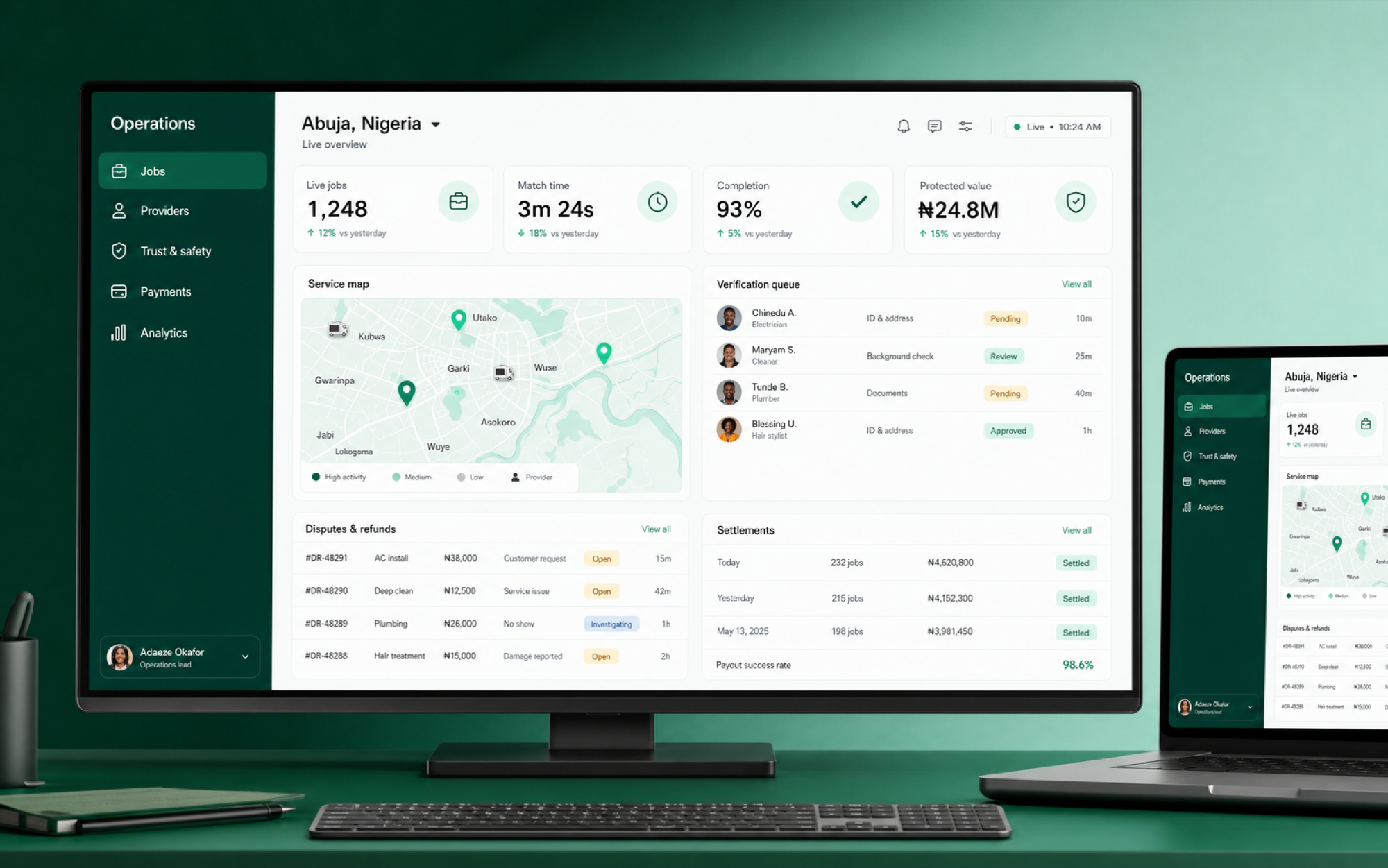
The value is not simply listing providers. The defensible work is coordinating a high-friction offline service through identity, availability, matching, communication, payment state, evidence and resolution.
When a pipe bursts or power fails, customers do not want an endless directory. They need a suitable person who can respond where they are.
Independent professionals need qualified demand, clearer work context, reputation and a reliable record of earnings.
Verification alone cannot resolve late arrival, changed scope, payment questions or service disputes. Shortime connects those events.
A city-first model can improve match speed, provider utilisation, field learning and local brand trust before geographic expansion.
The product wedge
The Abuja pilot focuses on plumbing, electrical and cleaning. These categories exercise the marketplace’s core trust and coordination machinery without spreading operations across every possible service on day one.
Category, description, photos, location and payment context make each request more actionable than a generic lead.
Verified skills, live availability and service area guide time-bound offers and automated rematching.
Arrival, work, payment, review and dispute events stay connected so the marketplace can learn and intervene.
Customer proposition
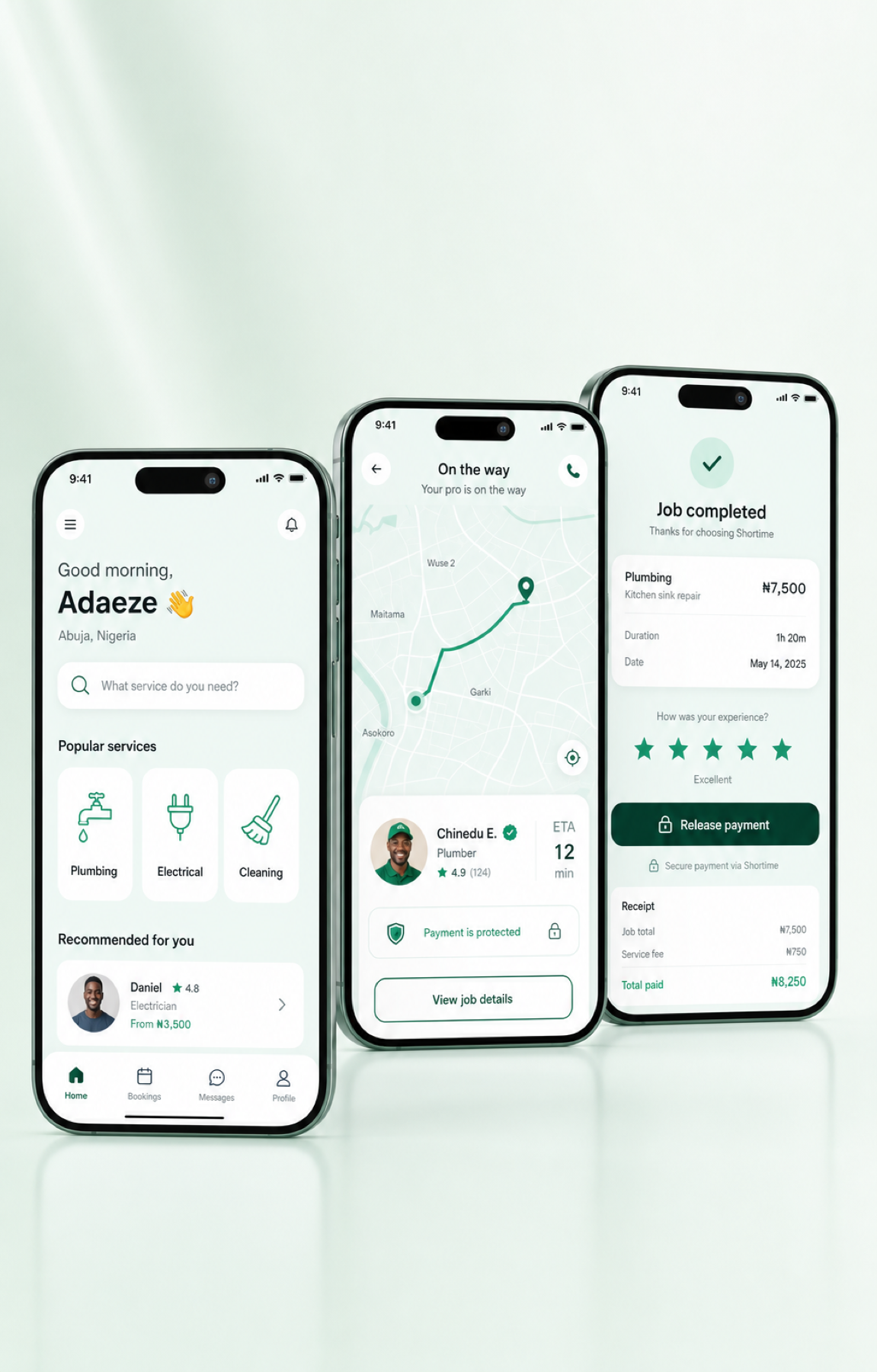
The customer journey reduces the search cost of finding help while preserving identity context, communication, progress, payment status and a support path.
Provider proposition
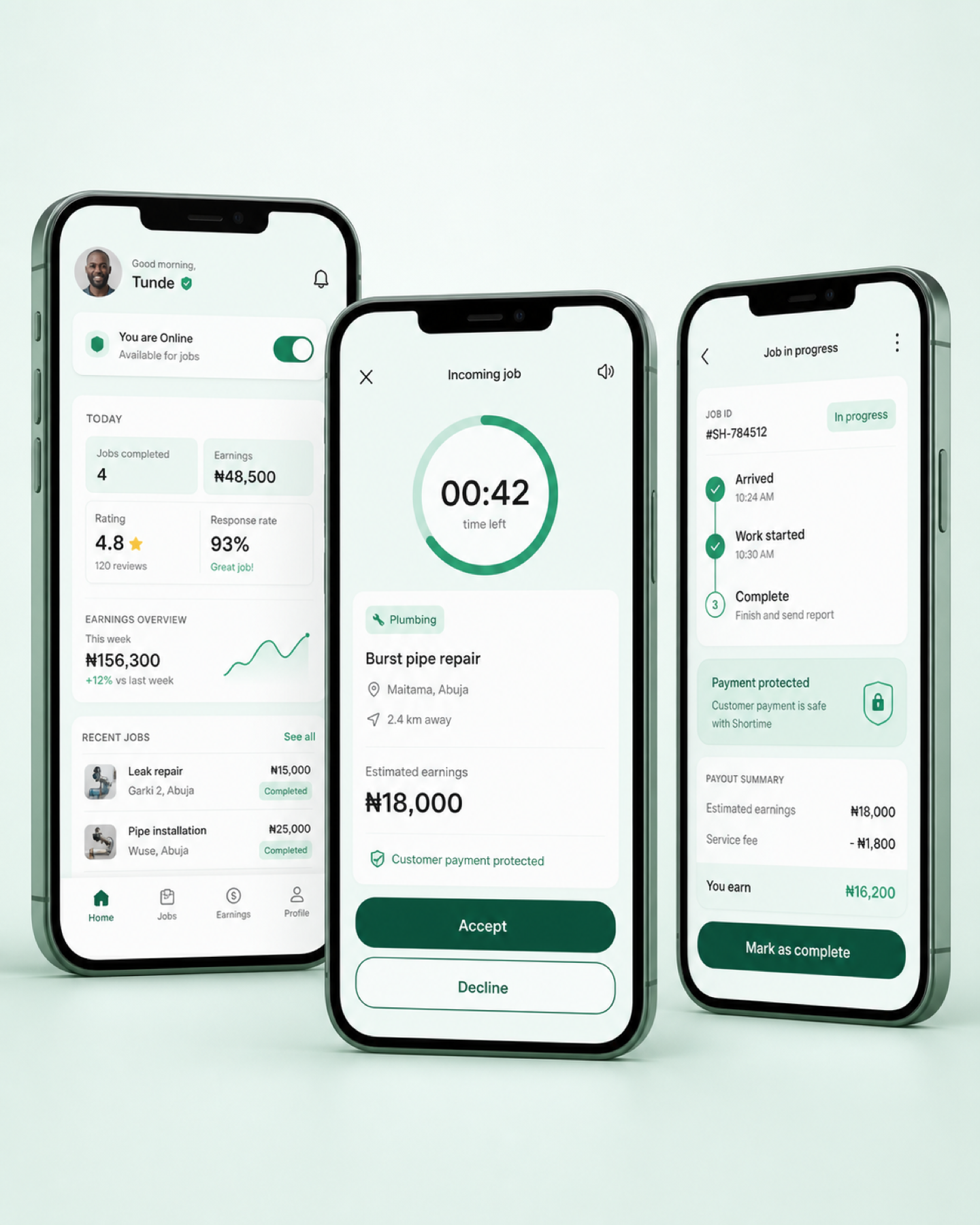
The provider app is not just a lead feed. It supports work acceptance, job execution, service reputation and earnings visibility.
Planned pilot scorecard
These are first-three-month goals from the launch plan. They are not historical performance or achieved traction.
Planned activated customer base.
Verified and available across launch categories.
Target service-volume signal across the pilot.
Planned job-completion quality threshold.
Target from request to accepted provider.
Target customer quality signal.
Planned signal that supply sees durable value.
Initial revenue target, not achieved revenue.
Additional planning assumption: average job value of ₦5,000–₦100,000. Actual mix, take rate, payment behaviour and unit economics must be validated in the pilot.
Business model
The launch model aligns initial revenue with successfully completed marketplace activity. Additional revenue lines remain optional until they improve—not distort—service quality.
Core
Shortime earns when a coordinated service completes. The model can align customer acquisition, provider utilisation, support quality and settlement discipline around the same event.
Potential layers
Future monetisation may include provider tools, managed accounts, promotions, subscriptions or embedded services. None should be treated as launched revenue before demand and regulatory fit are proven.
The operating moat
Every completed or interrupted job can improve supply quality, matching decisions, support playbooks and city-level operations—provided the system preserves structured events rather than losing them in private chats.
Launch sequence
The plan treats each phase as an evidence gate. Expansion follows operating readiness, not a calendar alone.
Recruit and verify an initial Abuja provider base, test operational queues and build an early customer community.
Operate plumbing, electrical and cleaning with close job monitoring and rapid learning loops.
Improve category depth, response time, provider retention, customer repeat use and operational leverage.
Transfer the city playbook only after proving what needs to be centralised and what must stay local.
Add cities, services and access paths as density, governance and unit economics support them.
Use of capital
The financing conversation should connect capital to milestones, not vanity. A detailed allocation belongs in the investor data room once round size and instrument are agreed.
Deliberate transparency: Shortime is not publishing a round size, valuation or completed financing on this page because those terms have not been supplied as approved facts.
Customer/provider apps, backend, staff portal, payments, observability and security.
Provider acquisition, verification, training, support and Abuja coverage quality.
Disputes, controls, reconciliation, privacy, legal structure and vendor readiness.
Local launch partnerships, useful content, customer activation and referral learning.
Diligence lens
We expect scrutiny around category economics, supply quality and operational risk. The right capital partner will help test these honestly.
Which categories drive repeat use, and what does a healthy customer/provider cohort look like by city?
How do acquisition, support, payment costs, refunds and incentives behave at different job values?
Which payment-protection structure, identity vendors and operating policies satisfy Nigerian legal and market realities?
Investor conversations
Email investor@shortime.io with your name, firm or syndicate, stage and cheque focus, relevant portfolio context and the questions you want answered first.